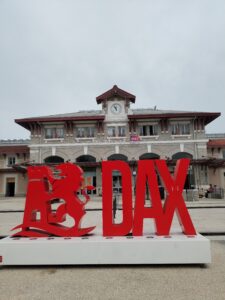
We decided to go for two days in Dax after sitting at the wrong end of the train from Bordeaux to Hendaye on the way back home to Bilbao last new year! The train separated in Dax and the end we were sitting in started circling back through France and heading to Paris. By the time we realised, we were in Lourdes, so we ended up on a mini-pilgrimage! Luckily the train staff sorted us out and we were on the right track after two hours in the Pyrenean village. We felt we owed Dax a visit for some strange reason, given the mini-trauma. In reality, we were there for three nights, giving us two full days to get to know the place, and we were pleasantly surprised by what we found.
You can read more about our adventures in Bordeaux at this link.
We like a holiday in which we can stroll around town, look in shops and drink a coffee or beer on a terrace, and this is a great wee town for that. Surrounded by history and young folks wandering around at night in party mode, there is a lively feel for a town which only has a population of about 22,000.
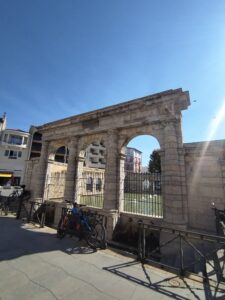
The Hot Fountain in Dax
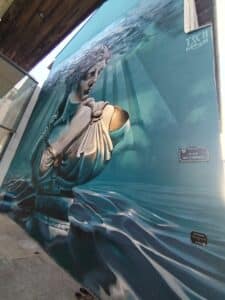
Nehe, la déesse de l'eau, in Dax
History
Apart from being an unassuming rail connection about halfway between Bordeaux and the border, it was also a significant Roman settlement, with some of the best preserved Roman ramparts in the region. The town had a certain importance in Roman Gaul and even had a visit from the daughter of Caesar Augustus, the first emperor. As the Roman Empire declined, the ramparts were built, which the later Franks took advantage of during periods of unrest and war with Basque populations, who lay nearby to the south.
Traditionally, the Basques controlled the area on the southern bank downstream on Dax’s river, the Adour. Dax shares the river with the nearby Basque city of Bayona (Bayonne in French). With this proximity to the independent-minded Basques, Dax was used as a defensive staging ground and administrative centre in an attempt to control local Basques living just to the north of the Pyrenees.
Later on in history, it was held by the English for several centuries, and returned to the French around the end of the Hundred Years War in the mid-1400s. You can see the history all around the historic part of the town, which is compact but full of life, and the historic walls are prominent.
The town continues with the upkeep of its history, and you can see various maintenance and excavation projects going on around the place. You can read a little more on the ongoing excavations at the following link.
The Hot Fountain in Dax
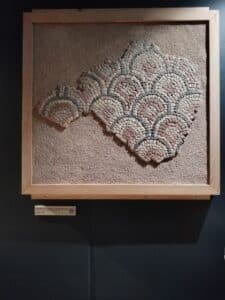
Roman Masaics in Dax
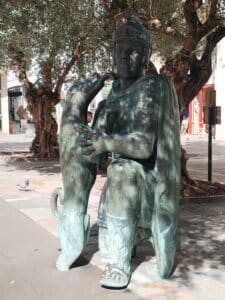
The Roman and his Dog in Dax
Thermal baths and magic algae
On the Place de la Fontaine Chaude, you will find a hot thermal fountain inside a 19th Century structure built over the remains of the ancient Roman baths. This acts as a centrepiece for the town’s ancient history and is surrounded by a lively plaza with lots of bars with outdoor terraces.
The fountain is barred up, so you can’t get togged out and dive in, so you will have to do that at one of the many thermal spas in town. You might want to think twice about bathing in its waters as they can get to upwards of 60ºC, and apparently locals used to use the fountain for cooking!
Strolling around the riverside, you will notice buildups of algae, which are also used in the therapeutic treatment of the various spas in town. The famous local story of the Roman and his dog, which we will see in a while, attests to the healing powers of the waterlife in the town.
The convergence of certain types of algae in the Adour river and deep-lying subterranean waters complimented with minerals buried deep in the earth on the water’s routes up to the surface has created a therapeutic magic around the town, so now we know why the Roman imperial family came to town for a bit of R&R.
Museums
There is little surprise then that the museum in town, which is in two separate parts about three streets away from each other, has much dedicated to the Romans. The first part of the Musée de Borda is built around an ancient roman excavation site, and contains extra artefacts. This is on Rue Cazade, not far from the hot fountain.
The second part is more focused on the previous few centuries to our present day and is on Rue des Carmes, which is only a few streets away. This part of the museum focuses more on antiquities from other continents, and artwork from several local artists, or artists connected to the area.
You can also buy various wines brewed with the ancient Roman process, both red and white. The one we bought is made with salt water, so we’re looking forward to trying that.
Other stuff
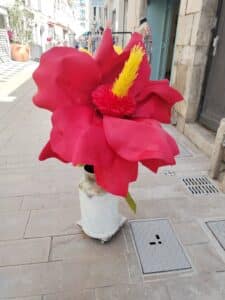
Street Flowers in Dax
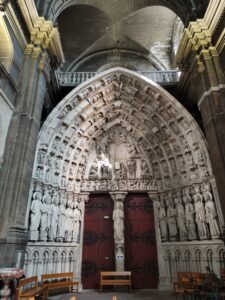
The 13th Century Apostles' Door in Dax Cathedral
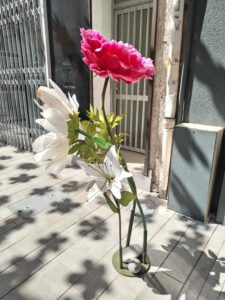
The Flowers of Dax
Cathedral
The Cathédrale Notre-Dame de Dax is in the middle of the historic area, and is classified as a national monument of France. There had been Romanesque and Gothic structures on the site, though the only remaining part of the old Gothic building is the 12-metre high Portal of the Apostles. The current building was built from 1694 in a classical style and looks over open space, one area replete with a statue of a Roman with his dog, reminiscent of a famous local story of a dog abandoned by its Roman owner believing it to be sick and dying. The dog immersed itself in the waters and algae of the Adour river and made a recovery, seeking out its overjoyed owner, so customer reviews of local spa treatment seem to go back nearly 2,000 years.
Markets
In the open space surrounding the cathedral, there is an indoor market, made mainly from glass and iron. It seems typical of many places on the French side of the border that we have visited, and Bayonne has a beautiful one of these. It is a typical food market where you can browse for local delicacies and drink something inside.
Outside and in the shadow of the cathedral, there seems to be an outdoor market presence of varying sizes on various days, especially on Saturdays. There you can find clothes and bric-a-brac, as well as food.
Shops
The reason I like wee places like Saint-Jean-de-Luz so much is its proliferance of small shops. Now I’m an impatient shopper, though my two regular travel partners are avid lovers of retail, but my stance is the bigger the shop, the more time spent trudging around it. Small shops are generally ten-minute affairs and you can always escape to a door which is a maximum of three metres away.
Dax is similar, with its pedestrian streets home to various little clothes shops, always with various items of street decoration and art outside, so even if you aren’t an avid shopper, you’ll at least have something to look at as you wait.
Street food and restaurants
You can get yourself a nice stuffed and roasted chicken, pork ribs and various cheeses and cold meats in the Saturday market instead of spending in a restaurant, of which there are many.
Like any self-respecting French town, there are plenty of eating houses dotted around the place, and the plaza with the hot fountain has a litany of restaurants on it.
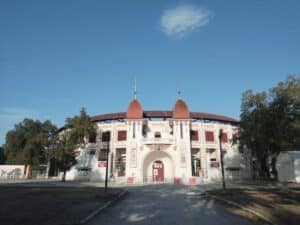
Bull Ring in Dax
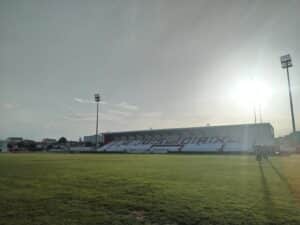
US Dax Rugby
Bullfighting
The French version is more humane and performers known as écarteurs and sauteurs confront and dodge the animal without capes or weaponry. Mind you, the Spanish version is also practised here, and Dax is one of France’s major bullfighting hotspots, with two annual festivals dedicated to the practice.
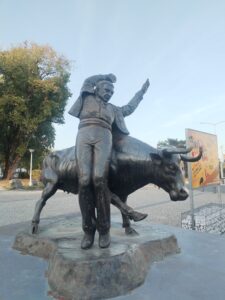
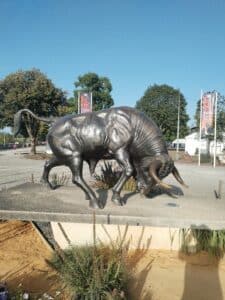
The bull ring, Arènes de Dax, is a typically artistic type of building with various statues dedicated to bullfighting and bull dodging outside. Our personal favourite is the statue of the bull and bull dodger competing in the Course Landaise form of bull leaping, as the bull gets to walk away alive and well.
Rugby
Across the street from the bull ring is the headquarters of US Dax, the local rugby club. They currently compete in the second tier for French rugby, and have been the team of various notable players. The Stade Maurice Boyau is named for an ex-player and famous air ace of World War I, and there is a statue of him just as you enter. Around the corner from the stadium is another statue in honour of Pierre Albaladejo, still alive and well at the time of writing and still with an ever-growing legend, having played his entire career for US Dax and having 30 caps for France.
Whenever we were there, the stadium was open for visitors to walk into and have a look around, though you probably shouldn’t walk on the pitch as we got a few friendly words of advice in French from a groundsman over that!
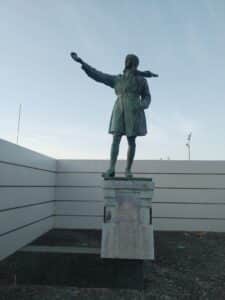
Maurice Boyau, rugby star and Word War I fighter ace, for whom the US Dax Rugby stadium is named
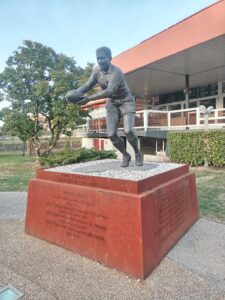
Monsieur Drop, AKA Pierre Albaladejo of US Dax and the French national side
Basques and French in harmony
While the town is unmistakably French in culture, there is quite a bit of overlap with Basque culture, with Basque traders noticeable in the markets around the cathedral. There’s also the appropriately named Txupinazo Bar on Place de la Font Chaude attesting to a sense of Basque-ness being about the place.
This is another selling point of the place, that it draws in surrounding and neighbouring culture. The Gascogne region is quite expansive and has various distinct areas, with the Landes area and its grand woodlands right beside Dax. Basque culture is right down the road, and Spanish culture can also be seen around the place, not just in the bullfighting but also with some of the food culture. Spanish is also spoken as a second language by a fair few people, so in the event of English not being spoken, having a few words in Spanish can be handy. We also noticed an Italian restaurant in town, close to the cathedral, so eating international is possible.
Would we recommend it and why?
The town has plenty to offer and we feel like heading back to it as for such a small place, it was teeming with life and activity!
It doesn’t have one unique selling point, but quite a few, and it could be used as a launch point for going into the Landes area. This is supposedly the biggest forest area in western Europe, and is full of water parks and nature reserves. If you are a nature lover or someone with kids, it is a good area to consider for holidays. Dax is also only about half an hour away by car from the coast, so driving there is handy. You might also consider using the bus services to get you to the many beaches on the Atlantic coast of south-west France.
It is a wonderful wee place, compact and cut in half by the Adour river, with leafy walks and historic streets. We don’t really feel like traversing the tourist hordes at more famous places, so a few quiet days here felt just like the doctor ordered. Two full days, or three nights was a good stay, but you could easily extend that in a place like Dax.
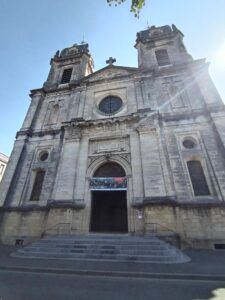
The Cathedral in Dax
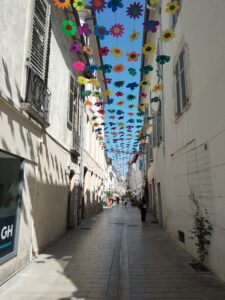
The Streets of Dax
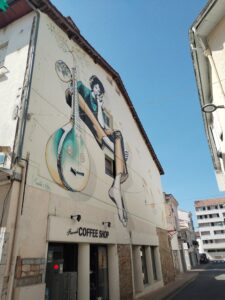
Coffee and Murals in Dax
Next time?
Definitely the spas! We need to remember that in France, things tend to close the way they do in Spain, only earlier. A lot of businesses seem to close around 12 noon-12:30, and sometimes stay closed, except on certain days. Some of the spas seem to open for the full day on Friday, yet not on other days, so it's best to plan ahead, before you arrive, which we will be doing in future.
I personally think a visit to Dax would work well as part of a train ride tour going from-or to Bordeaux, and possibly with Bayona or the other Basque towns. We did everything on SNCF, who run a decent service which connects the country. Bordeaux is between 60-90 minutes away and Bayona about half an hour.
We came from Hendaye, which is right on the border, having connected from Euskotren, which connects the other side of the border with the French SNCF train station and can take you to both San Sebastián and Bilbao. The Euskotren station is directly beside the SNCF train station and it is worthwhile investigating the various travel cards the Basque Country has to offer, as they will make a relatively cheap trip even cheaper.
You can check out SNCF’s website here, and Euskotren at this link.